

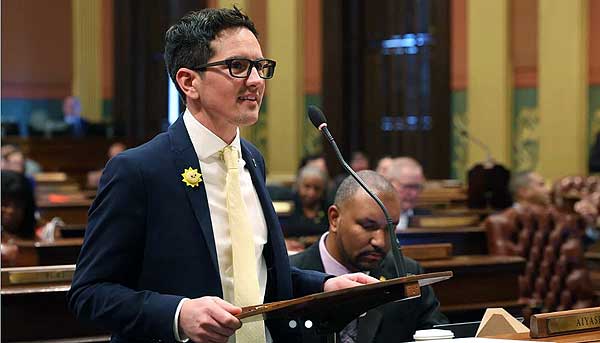

The poorly written, damaging to Michigan Sport Fishing commercial fishing bills have been introduced again. State House Bills 5801 and 5802, introduced by Representative Dave Prestin (former) and Representative Jason Morgan (latter), have been assigned to the House Committee on Natural Resources and Tourism. Note: Rep. Dave Prestin ((517) 373-0156 DavePrestin@house.mi.gov) is a member of the Natural Resources committee. Rep. Morgan (JasonMorgan@house.mi.gov (517) 373-0855) reportedly has family members in commercial fishing.
There’s a number of issues with these bills starting with the fact that a total of 59 sponsors have signed on to these tie-barred bills. That’s already more votes than the half needed to pass these bad bills out of 110 state reps, if the bills were to be reported out of the Committee to the floor. That could happen at any time.

What these bills do is rewrite Michigan commercial fishing law to pit it as an ‘equal’ against the Michigan Sport Fishery by adding multiple gamefish to the commercial fishing harvest, and allowing them to use just about any method possible to take those fish away from sport fishing including the use of deadly gill nets.
This is an attempt to put the $4 BILLION per year Michigan Sport Fishery at risk opposed to the few million-dollar commercial fishery. To do so also in vague terms and definitions that would almost certainly bring about law suits in the first year if the Michigan Department of Natural Resources Fisheries Chief does not give commercial fishing say, an equal percentage of the annual walleye harvest. It’s very probable this bill could cost the DNR a million dollars or more in law suits in the first year as the existing commercial fishers attempt to wrestle fishing harvest away from sport fishers for their profit.
The bills suffer from a number of errors including allowing commercial harvest of ‘yellow pickerel’ whatever that is?? I believe this is an old-time reference to walleye, but they ALSO mention the commercial harvest of walleye separately as an example of how poorly written these bills are.
Besides adding walleye to the Michigan commercial fishing harvest, they would allow perch and black crappie as well! No one has been able to explain why they are seeking commercial harvest of crappie. I’m not aware of a market for them, but they are specifically allowed in these bills. It’s important to remember some of the fish listed below as legal now to commercial fishing are supplemented often by stocking using dollars gained by sport fishing, NOT commercial fishing.
Other species allowed would be catfish, buffalo, burbot, carp, herring, chubs, suckers and whitefish. Lake trout, smelt and alewife are also referred to. Some of these fish are already allowed in existing commercial licenses. Much existing language is removed making it unclear if inland waters are also open to commercial fishing. It generally refers to the Great Lakes and connecting waters, but other language makes this vague, such as references to commercial fishing in rivers emptying into the Great Lakes?
It defines commercial nets as a fyke net, GILL net, hoop net, impoundment net, pound net, purse seine net, seine net, trap net or trawl net allowing just about every kind of possible net. It requires the MDNR to set annual quotas for ALL listed fish species without defining what that quota should or can be. I have heard they want 50% for example of the walleye. That’s the potential of less than 50 commercial fishers trying to harvest 50% of our walleye for profit. They believe they should have equal access to our GAME fish they desire despite the massive difference in value of Michigan’s sport fishery verses its tiny commercial fishery.
These bills also give additional protections to commercial fishers similar to the sport fishing harassment law. Things such as you cannot wade or swim in a manner or at a location likely to cause a significant alteration in the behavior of aquatic species in order to hinder or prevent the lawful taking of an aquatic species. What if a commercial fisher decides he want to put his nets next to a public beach?? There are severe fines and imprisonment up to 93 days for violating the new terms of these bills including the phrase “Engages in any other act or behavior for the purpose of violating this section.” Is it possible you could get a ticket just for fishing near commercial nets or lines?
I was told these bills do not force the MDNR to issue more, new commercial fishing licenses though the language to apply and do so is present in these bills, only limited by the vague terms of “sound scientific management through data gathering and analysis within each commercial fishing zone, shall determine the number of licenses needed to take fish within each management zone in an economic and profitable manner.” You think if walleye are added, more people will want to commercial fish them?
The bills also troublingly remove language the put important limits on commercial fishers about net placement limitations such as within 160 rods of on either side of a stream or river mouth, or an outlet of an inland lake emptying into the Great Lakes, and language that still allows for adequate safe passage of fish. Why would they remove these restrictions that are designed to prevent some conflict between sport fishing and commercial fishing?
Gill nets are particularly troubling because targeting walleye with them will lead to smallmouth bass being captured. It is common for fish to die in gill nets after a time even if the nets are pulled frequently. Yes, they would have to be thrown back, but they will still be dead to no purpose. There was language that dead fish not of the allowed species are to be dressed and given to the DNR, but that was removed along with language stating if more than 10% of dead fish other than ‘herring, chubs, perch and pilot fish’ (Menominee) are taken, then all of the other fish shall be disposed of by the department. Undersized fish restrictions were removed too, replaced by some size limits later in the bill.
Language that designated Saginaw Bay as rough fish water was also removed. They want access to the perch and walleye now there in particular. Net restrictions that previously existed for Lake Erie and Lake Huron and their connecting waters, or southern Lake Michigan OR rivers and streams that connect to these bodies of water have also been removed.
Targeted Fish including Game Fish
The bills do state what fish are allowed to commercial fishers from the waters of the Great Lakes open to commercial fishing as:
Walleye
Black crappie
Lake whitefish
Yellow perch
Lake Trout
Rainbow smelt
Round whitefish
Bloater chubs
Cisco
Most sucker, hogsucker, quillback and buffalo
Freshwater Drum
Burbot
Gizzard shad
Common carp
Catfish and bullheads
White perch
White bass
Rock bass
Alewife
“By December 31, 2025 and each year thereafter, establish a total allowable harvest for lake trout, walleye, and perch within the waters of the Great Lakes that are under the jurisdiction of this state and allocate a portion of the total allowable catch for each species within each management zone open to commercial fishing based on the market demand for those species used for human consumption and the opportunity for a licensee to fish in an economic and profitable manner.”
This is example of where the law suits will come from. What does any of that actually mean, and how can the Fisheries Division work with that? Market demand and profit should not be deciding factors for commercial fishers wanting to take our sport game fish.
“All live fish on which the season is closed or is not authorized for harvest must be returned to the water at once with as little injury as possible by the person taking the fish. Any dead fish, on which the season is closed or is not authorized for harvest, must be returned to the water at once by the person or persons taking the fish or disposed of in accordance with any specific instructions provided by the director.”
I believe they want to be able to keep non-allowed commercial fish and sell them as bycatch. The language removed, and the language like the previous quote may open us up to the sale of ‘accidentally’ caught smallmouth bass.
This additional language seems to say otherwise, but they appear contradictory to me added to other language in the bills:
“A person shall not sell or offer for sale at any time fish not listed in subsection (1 – the list of allowable fish above) when the fish was taken under a commercial fishing license issued by this state. Any such fish, whether dead or alive, must at once be returned to the waters from which it was taken by the person or persons taking the fish with as little injury as possible. (8) A person shall not sell or offer for sale any fish not listed in subsection (1).”
“Black crappie, also known as calico bass, in Lake Huron from June 1 to August 25. In Lake Erie, Lake Michigan, and Lake Superior, black crappie may not be taken at any time.” This appears to be old language in commercial fishing law, but white crappie is not mentioned and not listed under the allowable fish. Do commercial fishers know how to accurately tell the difference between white crappie and black crappie. Is Lake St. Clair open or closed to the commercial harvest of crappie?
There is a penalty for any commercial licensee that retains more than 5% undersized fish at any given time on board a vessel, truck or fish storage facility, which is odd because they are not supposed to keep undersized fish?
Other bad language, they keep in their separate definitions for minimum length of 17 inches on both lake trout and ‘ciscowet trout’ which is an alternate spelling of an old name for lake trout apparently. To be clear, it should just be lake trout. Kind of like walleye referred to in places, while other places refer to ‘yellow pickerel.’ And they have separate lengths of 15-1/2 inches for walleye with 11 inches for ‘blue pike???’ What does that even mean?
5801 is a very long bill with a lot of confusing language including removals and additions. Some old, many new, that make it difficult to determine the full consequences of this becoming law, but the gist of it is commercial fishers want walleye and perch to take and sell, and this could seriously impact the dramatically more significant sport fishery that is vastly more important to the State of Michigan, and also, sport fishing has paid for massive stocking of walleye, not commercial fishing. Why would we give them ‘their share’ of our fish?
Take Action
There are so many things wrong with this idea, and the bills as written, the only action to take is to oppose them completely. You can contact your Michigan state representative and ask them to oppose 5801 and 5802 as very bad for the vastly more important sport fishery of Michigan.
If your rep is a sponsor of the bill, ask them to remove themselves from that list. You can also contact the chair (Rep. David Martin – Republican District 68) and members of the House Natural Resources and Tourism Committee: Alicia St. Germaine (Republican) District-62 Majority Vice Chair, Rep. Mike McFall (Democrat) District-14 Minority Vice Chair.
Members:
Rep. Curtis VanderWall (Republican) District-102
Rep. Pat Outman (Republican) District-91
Rep. Mike Hoadley (Republican) District-99
Rep. Gina Johnsen (Republican) District-78
Rep. Dave Prestin (Republican) District-108
Rep. Karl Bohnak (Republican) District-109
Rep. Parker Fairbairn (Republican) District-107
Rep. Jennifer Wortz (Republican) District-35
Rep. Helena Scott (Democrat) District-8
Rep. Regina Weiss (Democrat) District-5
Rep. Noah Arbit (Democrat) District-20
Rep. Morgan Foreman (Democrat) District-33
Rep. Tonya Myers Phillips (Democrat) District-7
Rep. Stephen Wooden (Democrat) District-81
Following are the links to the latest language and status on each tie-barred bill (meaning they both have to pass as a pair):
https://www.legislature.mi.gov/Bills/Bill?ObjectName=2026-HB-5801
https://www.legislature.mi.gov/Bills/Bill?ObjectName=2026-HB-5802
Here is the complete list of the bills’ sponsors as of 5/5/2026 5:42 PM (updated 5/13/2026 7:21 PM):
Gregory Alexander (District 98) R
Noah Arbit (District 20) D
Brian BeGole (District 71) RMatt Bierlein (District 97) R
Karl Bohnak (District 109) RKen Borton (District 105) R
Kelly Breen (District 21) D
Julie Brixie (District 73) D
William Bruck (District 30) R
Erin Byrnes (District 15) D
Brenda Carter (District 53) D
Cameron Cavitt (District 106) R
Jennifer Conlin (District 48) D
Nancy DeBoer (District 86) R
Jay DeBoyer (District 63) RParker Fairbairn (District 107) R
Morgan Foreman (District 33) D
Carol Glanville (District 84) D
Jaime Greene (District 65) R
Peter Herzberg (District 25) D
Kara Hope (District 74) D
Nancy Jenkins-Arno (District 34) R
Gina Johnsen (District 78) R
Tim Kelly (District 93) R
Matt Koleszar (District 22) D
Tom Kunse (District 100) R
Matt Longjohn (District 40) D
Sharon MacDonell (District 56) D
Matt Maddock (District 51) R
Gregory Markkanen (District 110) R
David Martin (District 68) R
Jasper Martus (District 69) D
Mike McFall (District 14) D
Donavan McKinney (District 11) D
Luke Meerman (District 89) R
Reggie Miller (District 31) D
Jason Morgan (District 23) D
Jerry Neyer (District 92) RPat Outman (District 91) R
Veronica Paiz (District 10) D
Tonya Phillips (District 7) D
Bryan Posthumus (District 90) R
David Prestin (District 108) R
Natalie Price (District 6) D
Angela Rigas (District 79) R
Ron Robinson (District 58) R
Julie Rogers (District 41) D
John Roth (District 104) RKathy Schmaltz (District 46) R
Bradley Slagh (District 85) R
Alicia St. Germaine (District 62) R
Samantha Steckloff (District 19) D
Penelope Tsernoglou (District 75) DDylan Wegela (District 26) D
Jimmie Wilson (District 32) D
Stephen Wooden (District 81) D
Jason Woolford (District 50) R
Jennifer Wortz (District 35) R
Douglas Wozniak (District 59) R
I have updated this article on 5/12/2026 striking out the names of 2 State Representatives so far who have removed themselves as bill sponsors.