
Great Lakes. Until you actually fish them, you have no idea how small you can feel in a bass boat. The bass fishing is some of the best in the world, but as with all good things, there’s a price at times. It can get really rough out there – Edmund Fitzgerald rough.
It isn’t that rough always, but between the wide-open spaces and – on some areas such as Lake St. Clair – the large pleasure craft traffic, uncomfortable and even dangerous waves are a fact of life for the Great Lakes bass angler.
Bass boats are designed to be fast and efficient in shallow, protected waters, and although more of them are now built larger and deeper to handle the bigger waters many bass anglers fish, there are times you will get bounced around pretty good and soaked too. Some of those days, you have to decide ‘do I go out in that stuff?’ Or stay home and watch the Bassmasters on TV?
Some of us push the limits and make runs we probably shouldn’t be making too. At times, it comes down to a choice to endure or not fish on the Great Lakes, or at least not head to the place you really wanted to fish that day.
There is an alternative though that a few innovative bass anglers are starting to investigate.
One of those anglers is Clinton Township bass tournament angler Dave MacDonald, the 2001 Canadian Open Champion. Dave is no stranger to big water since he’s fished on the Great Lakes even before he began fishing bass tournaments out there 20 years ago. He’s a regular at many St. Clair and Erie bass events, and often ends up near the top of the standings.
Dave MacDonald is a competitor and does not want to have anything hold him back so this year he decided to experiment a little. Dave is aware that many boat manufacturers are making larger, deeper boats to capitalize on the upsurge in the walleye tournament market. Since walleye anglers tend to troll more and commonly fish out in the open, vulnerable to the elements, their boats tend to resemble beefed-up bass boats.
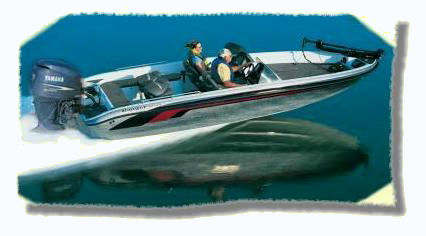
Dave traded in his familiar bass rig this year for a Ranger Boats 621VS – a large boat aimed at the walleye/multi-species market and particularly aimed at the big water angler. Bass Lines caught up with Dave recently to see how his experiment was progressing.
Djkimmel: “Dave, you’ve used your new Ranger 621 for a few months now in your big water events. How do you feel about fishing out of a ‘walleye’ boat in bass tournaments?”
Dave: “It’s pretty cool! Every one of my partners who have been in it have been impressed with the boat.”
Djkimmel: “How does the ride compare to a traditional bass boat?”
Dave: “The boat rides great. I had the shock absorber seats installed and that really makes a difference. But it isn’t just about the ride. It’s also about the comfort. The Ranger 621 is the driest boat I have ever been in. At many of our tournaments you always see guys coming in soaked. Most of the time now, I don’t even put on my rain gear. I don’t understand the physics of it, but I’ve never had a wave come over the nose while running. It’s drier than some of the bigger 23 and 24 foot fishing boats I’ve been in over the years!”
Dave: “The boat is so forgiving. This past weekend, they had a huge event on St. Clair that attracted even more cruisers than normal. There were trying to set some world record for the most boats rafted on a lake. We came back in through a really rough 4-foot cross-chop. I just drove a steady 30 miles per hour. We sat back talking and drinking water like it was flat calm around us.”
Djkimmel: “So, has the boat changed how you approach your tournaments on the Great Lakes?”
Dave: “Yes, it has. You know there are days out there so rough, you really question whether or not to make the run. With my 621 now there is no hesitation. If I want to go, I just go. I know the boat can take it, and because the ride is dry and so much smoother, I know I’ll be feeling fresh and ready to catch bass when I get there instead drained and warn out before my fishing even starts.
Djkimmel: “Have there been any drawbacks to competing in a ‘walleye’ boat against other anglers in bass boats?”
Dave: “The only thing I’ve found is the top end speed is a little lower. It’s a 55 mile per hour boat. The bass boats beat me in the shallow flat water, but as soon as we are out in the big water, the advantage flips around. I can run the waves at a faster steady speed and I get there feeling a whole lot better and calmer than the others do.”
Djkimmel: “How about fishability?”
Dave: “For the Great Lakes, it does everything perfectly. You can do anything in it you would normally do from a bass boat. The only thing I could see would be flipping and pitching because of the high sides being a little different. But we don’t do much flipping out on the big lakes.”
Djkimmel: “How do the internal things compare like livewells and storage?”
Dave: “Ranger divided the huge rear well for me. It’s a bathtub. I also have a livewell up front. I like to use it to separate out problem fish from healthy bass. I also use it for efficiency when I’m really catching them. I’ll put my bass in it. I never have to leave the front deck. Because the boat rides so smooth, the bass don’t get beat up in the front well either like they use to in the old bass boats.
Dave: “As far as storage, it’s every bit as good as my bass boats have been. The side boxes are a little shorter than I’m used to but it has a large rod box in the middle of the front deck that holds everything well. Ranger put in the back deck insert for me too and there’s so much space under that I went out and bought a couple large plastic bins to keep my partner’s things in so they’d stay near the front instead of sliding way back under.”
Djkimmel: “So you’re pretty satisfied at this point?”
Dave: “Oh yeah. I don’t think I’ll ever go back to a bass boat.”
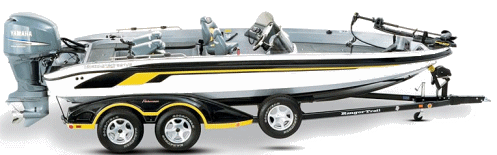
The Ranger 621VS is 21’ 3” long with a wide 94 ¾” beam and 25” depth. It’s rated for a 200 to 250 horsepower motor and has a 55 gallon centered gas tank. Many bass boat manufacturers are now building multi-species boats for the walleye and big water market. If you fish the Great Lakes or other large waters a lot, you may want to consider this type of boat for added comfort and safety. It may open up more options for you while tackling the rough stuff. Dave MacDonald took the plunge and he’s not going back.
*Article originally published in the Michigan BASS Chapter Federation Bass Lines magazine – September 2004 issue.