
Improve your ice fishing with this hot technique!
On the frozen waters of Northeast Indiana, there’s a quiet buzz getting louder. It’s putting ice anglers in a trance causing them to follow others around in a stupor of what they’re witnessing: the noodle rod. Jack Cook, creator of King Noodler noodle rods, explains, “Every year, on multiple occasions, I have people following me around the lake trying to figure out what I’m doing.”
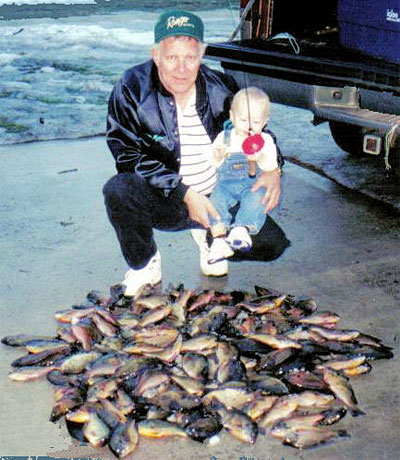
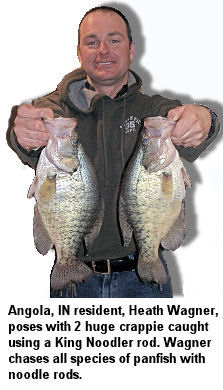
He’s not the only one either, a trio of friends from Angola, Heath Wagner, Brad Jones, and Leonard Myers (shown here with his grandchild and a mess of proof), who use King Noodler rods extensively, experience the same phenomena. Wagner relates, “I can’t tell you how many times we have gone out on the ice to find others struggling to catch 1-3 fish and we end up with 50 or more.
Many end up following us around. It sounds like a fish story, but truly happens nearly every time we’re out.”
When they were first using the noodle rod, Myers & Cook recall a time on Lake James when there were nearly a 100 people on the ice and all but they, were struggling. People began following them around and encroaching on their space. The 2 then decided to split up and head opposite directions to deter them. To their surprise though, the anglers split up as well and followed them individually. The crowd is now something they’re accustomed to.
King Noodler rods by Cook are made with fiberglass. 30 years ago, when he first began making his own, he used graphite, but learned that fiberglass “is more sensitive and… lasts longer.” He describes the rod as an “ultra,ultra-lite pole with especially slow action.” There are 2 models: an 18-20 inch and a 30 inch model. Both have their advantages. The shorter rod is stiffer, therefore less affected by windy conditions. However, a longer rod will generally detect bites more efficiently and gives the bait better action. An advantage Cook’s rods have over other noodle rods are his eyes and tips. He uses light wire claiming it balances the rod more effectively. Heavy wire will ruin the action.
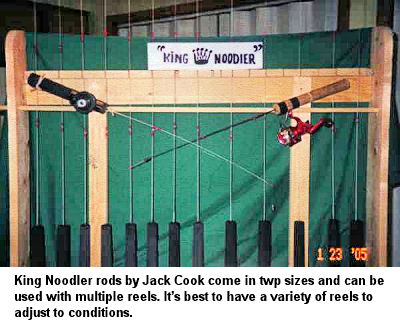
Myers was turned onto the noodle rod by Cook and in turn taught Wagner and Jones how to use it. In fact, Myers helped Cook fine-tune the rod to what it is today. Together they mastered the art of sanding down blanks with belt sanders. Myers recalls, “30 years ago, we bought some noodle rods from Dancing Bear Bait Shop and (Cook) had a lot of success. I struggled. Finally, he showed me how to use it the right way. I caught tons! With time though, they wore out and we needed new ones, but the bait shop was out of business. We worked on sanding down the blanks of other rods until we came up with something equivalent.” Cook continued to make and sell the rods. In recent years word of his craftsmanship has traveled and the interest has intensified.
These anglers use a noodle rod everywhere they go; in either shallow or deep water and target all species of panfish. They’ve had sacks of fish in excess of 100 in a single outing. Jones claims, “We routinely clean over 100 fish an outing.” Wagner claims the noodle rod will “outperform all other ice fishing tactics 99% of the time.” Their success with the noodle rod is so amazing, Myers actually walks around the ice with extra rods to sell to the onlookers. Myers also recounts a trip just last February to Southern Indiana when his group of 5 caught over 1800 bluegill & redear in just 6 days. Every fish was caught on a King Noodler.
Like all fishing, technique with the noodle rod can vary, but these anglers use a similar approach and make adjustments according to the bite. Here’s how they do it: begin by dropping your jig to the bottom and work its way up to and past the fish. Wagner tries to illustrate, “As you start to raise your jig past the fish you have to ever so slowly (and I stress that), pulse your rod up and down. I raise my rod an inch or two every second.” Jones urges that you must develop a cadence with the rod tip – a pulsing action. “If you have the cadence down, any variation is a fish. Set the hook!” He adds that, “Bluegills, in particular, like to follow baits up until they can’t take it any more and bite.” They all agree that an angler should experiment with retrieves if this does not work, as they have all experienced days when fish would only bite a sharper hop, faster retrieve, or deadsticking. However, the retrieve elaborated, rarely fails.
Although this technique is easy to duplicate, the anglers still rely heavily on electronics to locate fish. Wagner & Myers prefer FL-20 Vexilar units while Jones uses a Lowrance M68 graph. But not only do they locate fish with these units, they also watch their jigs on the unit as well. In fact, with both their jig and fish located on screen, they can line the 2 up and easily coax the fish into biting, as Wagner boasts, “90% of the time you can actually talk the fish into biting.” Myers adds that, “You can watch the fish to see if they are following (the bait) and you can move through a lot of holes searching for active fish.”
All 3 anglers use their electronics differently. Once Jones figures out the fish he’ll remove his unit claiming it can get in the way or you could get stuck watching the unit and miss the bite, yet Wagner will keep it in the hole 70% of the time. Myers will use his Vexilar for the first 60-90 minutes until he determines the depth and location of the fish, and turn it off. Myers also warns, “Sometimes the fish will wrap themselves around the transducer and break your line.”
Wind can wreak havoc though as Myers explains, “Heavy winds are the toughest condition that I encounter. All bites (with the noodle rod) are by sight, not feel.” The wind will cause the rod tip to “whip” making it, as Jones says, “difficult to discern the bite.” However, there are tricks an angler can apply to combat the wind. Begin by using a shorter rod as they tend to be stiffer. Wagner adds, “Block the wind with your back and hold the rod closer to your body.” Cook suggests an angler use 2 jigs with a stiffer rod when the wind is strong. That will apply more weight and pull the line straighter.
The most common reel used with noodle rods is standard slater reels. Myers states that other options are available, but he chooses a 2.5 inch slater. Jones also uses the slater but is conscientious of the weight: always choosing the lightest possible. Wagner admits you can use a spinning reel, but recommends avoiding them. He cautions that line guides frequently freeze up and will ultimately cost you fish.
The line matched up with the rod is vitally important according to Cook. All of these anglers use fluorocarbon line, as Jones adds, “The line will take a lot of abuse on the side of the hole and fluorocarbon is the best abrasion resistant line.” However, Cook warns that a noodle rod will not work with line larger than 2-pound test. “Line bigger than 2-pound test will cause the line to float which absorbs the shock and ultimately kills the action.”
Bait selection is not as significant, but basic ice fishing principles apply. In clear water, darker colored jigs are preferred, while the opposite is true in dark water. All 3 anglers prefer size 12 or 14 hooks and are especially fond of moonglitter jigs. At times, these 3 will also experiment with hooks as small as size 18. The anglers will also use ice flies with the same-sized hooks. At times, they will fish 2 jigs simultaneously. Myers suggests, “Use size 12 in deep water and size 14 in shallow water. Also, use an ice fly 12 inches above a size 12 hook.” All anglers tip their jigs with spikes.
It may seem that these anglers drill a hole, drop their jig down, watch the electronics, and catch fish with little effort, but the opposite is true. Wagner expounds, “Before I ever drop the first line, I will cut 20-30 holes in both shallow and deep water. Most days you will not be able to stand over one hole and catch fish after fish out of it. I normally will only fish a hole through one rotation of my technique and then I simply pull out and move on.” A common characteristic of these anglers is they are constantly on the move, because they will not stand still for long hoping for fish to bite. This is where the advantages of the electronics and drilling numerous holes come into play.
With a flimsy rod and nothing to reel the fish in, how does one bring in a big bluegill in 20 foot of water? All 3 anglers use the same technique; Wagner describes it best saying, “In water shallower than 8 feet, a quick snap of the wrist and forearm will simply pull the fish straight out of the water. In deeper water employ a triangular method: Pull the rod over your head; then grab the line while maintaining pressure on the fish; next take the tip of the rod and bring it under the line you’re holding, use it to lift the line further out to finish pulling the fish through the hole. If the water is really deep you will need to repeat the process by wrapping the line around your hand and rod tip as many times as it takes.” Jones points out that by not reeling up any line, you now know exactly how deep the fish are holding, but he warns, “The thing to remember is to avoid stepping on your line after unhooking the fish. This could damage your line.”
Noodle rods can be purchased at bait shops in the Angola area. Big D’s Bait & Tackle has been carrying them the past year starting at a price as low as $30. When purchasing a rod, Cook gives the following advice: “I always recommend the longer model: they last longer. The shorter rods are a bit stiffer, which helps in windy conditions, but after a few years of extensive use (40-45 days per season) they may crack. Also, keep in mind that all rods, short or long, are unique. Some have a stronger backbone than others. Before purchasing, hold a few to determine which one feels best to you.” Cook backs up his product as well, “Each rod is custom tuned to my specs and tested by me before it goes up for sale. They come with a free replacement guarantee for material defects.”
Owner of Big D’s, Derek Wyatt, recommends that interested buyers plan on purchasing before the ice season begins due to demand, “I have had requests for them since early September. They sell like hotcakes once the season begins.”
These Angola anglers are gaining a literal following on the ice and they are not changing a thing. Myers offers a simple explanation: “Noodle rods outperform all other rods at all times. I have used these rods for 25 years and will never go back to bobber fishing.” Jones adds, “If you’ve ever seen a person watching their bobber for 15 minutes without any bites only to notice his hook cleaned, it’s because of subtle bites. With a noodle rod, you’ll catch those fish.” Take the advice of these anglers and cash in on the Northeast Indiana trance; purchase a noodle rod and fill your freezer today.
(Big D’s Bait & Tackle is located at 2445 N. SR 127 Angola, IN 46703 and can be reached at 260-665-8414.)