Good
Advice on Making
Sacrifices – A Quote by Roland
Martin
Over
the years, many young people and
aspiring pros have asked me
for the best career advice I could give them. My answer has always been
simply "come early and stay late."
Fishing is like anything else
- you get out of if what you put into it. In this sport, there is no
substitute for experience. And you only get that from spending time on
the water. I see fishermen shortchange themselves by not spending
enough time on the water or in tournaments not using the whole practice
day.
But another way
fishermen
shortchange themselves is by not really using their time on the water.
By that I mean not concentrating on what they're doing enough to learn
from every hour that they spend on the water, whether they're
practicing for a tournament, guiding or just fun-fishing.
Top Tip
– Snap Jigging - Tube & grub fishing for the (hyper)
active angler
Personally,
I prefer to fish spots by casting. I only drift and drag
when someone forces me to. That's why I like snap-jigging so much when
tossing tubes and other jigs.
Things are rarely boring with this aggressive retrieve. It doesn't work
just on active fish either. Smallies especially are like cats when
resting - they can't help but take a swipe at something that jumps past
them.
Often, the main trick to getting smallies to bite is
just getting their attention. Snap-jigging really gets their attention
– sometimes so well that they virtually ignore other nearby
lures. I’ve out-fished anglers many times with this varied
technique.
Along these lines, consider the weight of the jighead also
since
a heavier jig will fall faster and possibly trigger more reaction
strikes. You can hook bonus bass out of schools this way after you get
the initial strikes from the more active bass.
One
thing my underwater
camera has taught me about smallies in particular, something I was
suspicious about, is that there are almost always more bass on a spot
then what you catch.
The trick is to figure out how to get them biting again after
the bite
slows, especially during those times when they aren’t biting
everything that passes by. I use various snap-jigging methods for this
often. It works and it keeps me on top of my game too.
There isn’t a single retrieve that I call
snap-jigging, but
any active, aggressive tube retrieve. The one I use the most is simply
to let the tube with a ¼ oz jig fall to the bottom and sit
for a
couple seconds. Then snap your rod up from 9 to 11 o’clock to
pop
the tube off the bottom. Let the tube fall back to the bottom on a
semi-slack line. Watch for line jump signaling a strike. Let it sit on
the bottom for a couple seconds again and repeat the snap. Watch for
followers. I catch many smallies right under the boat this way.
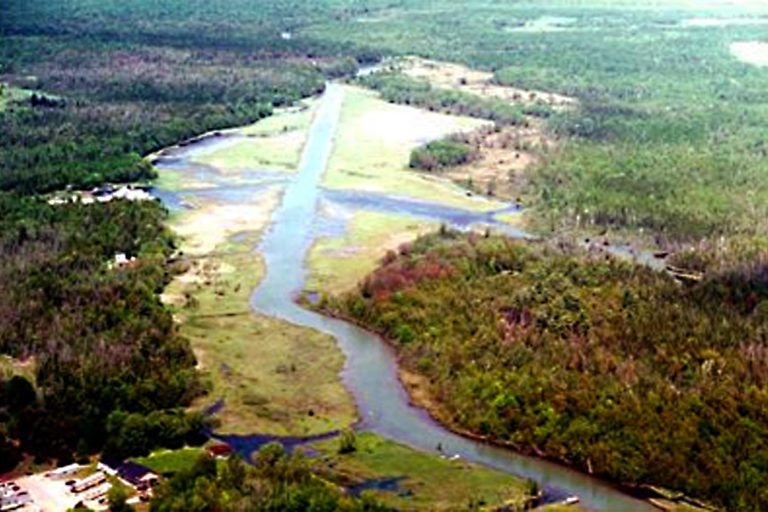
I
like this shot of Hay Lake on
the Crooked River near Alanson, MI.
Photo by Dan Kimmel
You
read about the big name professional anglers doing it all the time, but
rarely hear of other anglers, tournament or especially non-tournament,
doing it. I'm talking about flying over lakes. It's not that expensive
when you consider how much it costs to travel to a new (large) lake and
spend days, weeks, or longer (if at all) learning what you can in a
couple hours flying over.
Underwater
structure and objects immediately become visible from the
air...and contours easily overlooked at water level
really stick out. I've flown about a dozen lakes and figure I saved
myself untold months of searching empty water in the process.
This
has been
especially critical when you consider how large my usual
stomping grounds are - the Great Lakes. Talk about some water to
search. In the past, I flew Lake Erie - Bass Islands since I'd never
been there. I took a camera, notebook and portable GPS. I marked many
spots and recorded the sites with the camera. One in particular looked
very promising. Derek immediately singled out the picture and said we
had to visit there one of our first stops.
We
pulled up
directly on the spot using the GPS coordinate. It didn't
look much different than surrounding water at first, but (and this is
the truth absolutely) we caught 7 keeper smallmouths in 7 casts. Over
the years, that spot has produced a lot of bass for us.
This type of
situation has occurred numerous times on other waters
since. I won't go into further detail here since I only wanted to pique
your interest. Eventually, I plan to add an indepth work on this topic
to my articles page.
Tip #2 -
Sponshorship Resume Improvement for Aspiring Pro Anglers
by Dan Kimmel
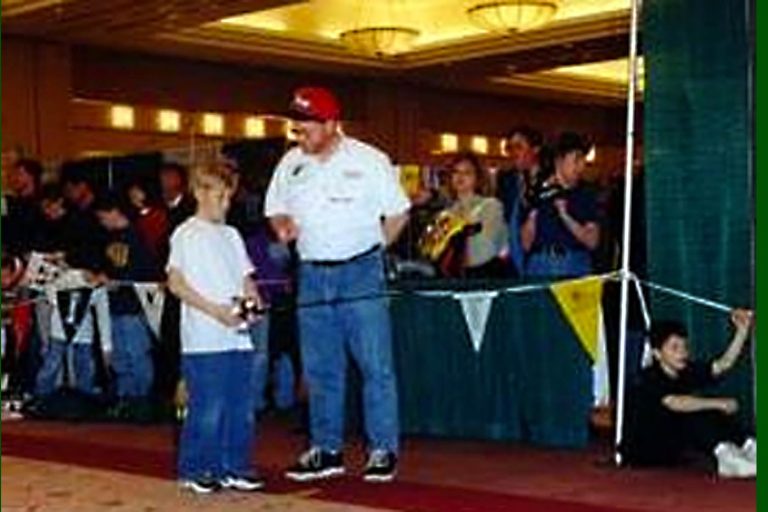
Giving
instruction at the Michigan BASS Federation CastingKids state
championship.
Photo by Wayne Carpenter
Before
Professional Angler magazine closed shop, they reinforced a great tip
for improving a resume to prospective sponsors. Many sponsors said they
see very few pictures in resume/portfolio's from anglers asking for
sponsorship that show the angler working with the public - especially
with kids. Next time you work a show or help out a youth event, take a
camera and have a friend get several quality photos for that purpose.
These photos in a resume can really set you apart from the rest of the
crowd.
For
general use to copy into a resume, shoot glossy photos with a good
inside speed such as 400 – which can handle some movement if
you have a flash and aren’t too far away from the camera. You
can scan the photos for a website or you can use a digital camera to
simplify
this. You’ll need lower speed film and a good flash
for photos you want to blowup. If there’s any chance you need
shots for a magazine, at minimum, you may need to shoot slide media
such as Kodachrome 64 or Fujichrome 100
depending
on requirements of
the magazine. More magazines are accepting higher quality digital
photos
now too - find out before you use a digital what their limits are (most
magazines have writer and/or photographer guidelines you can request by
SASE). Always contact any magazine editorial staff and ask for their
writer/photo guidelines
before trying to submit anything - that will put you ahead of the game
from the start.
If interested,
Tim Tucker has a pro angler advice newsletter
- Pro Angling Insider
- you might find it
helpful.
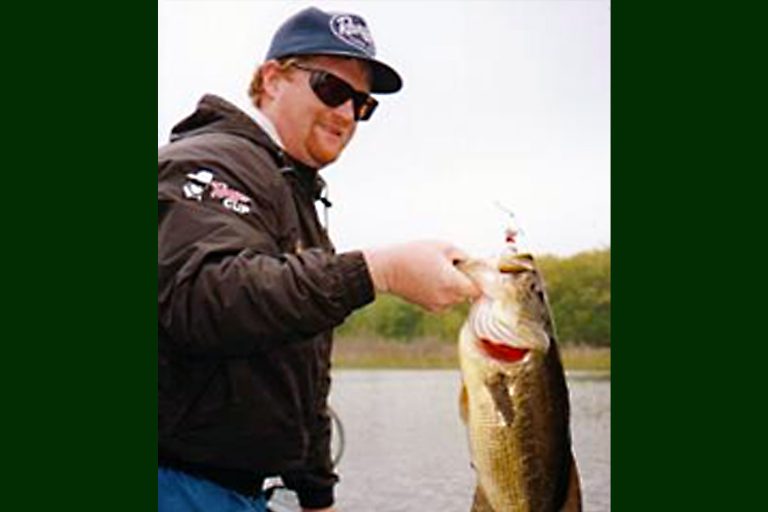
This
big, old largemouth bass couldn't resist a fast buzzbait.
Photo by Mark Gomez
Tip #3 -
The Need for Speed -
Speed up to Trigger Reaction Bites
by Dan Kimmel
If
the
bass give me a choice, I'll throw so-called power baits - spinnerbaits
and crankbaits. When the bite gets tough, I don't always immediately
switch to slower or finesse presentations. Bass that seem less active
can still be triggered into biting a spinnerbait if you go for a
reaction bite.
The
trick is to speed up your retrieve. I mean really speed it up so
you're forcing the bass to react in an instant. At times the difference
can be catching nothing at other speeds while the high speed approach
bags bass after bass.
I
recently returned from Lake Hamilton (Hot Springs, AR) It was the
first week in December with water temps in the low 50's. Since I was
pre-fishing, I moved along at a brisk pace which made slow
presentations difficult. I didn't get bit at all at first. A local
angler mentioned he was getting bit fishing a spinnerbait fast.
This
goes against the grain for cold water bass
fishing, but one of my
first few casts at warp speed produced a 16" largemouth. The bass
barely got the long trailer hook I
was
using, but I saw the whole attack. It was obviously a reflex/reaction
strike from a bass whose heart wasn't totally in the attack, but just
couldn't let the (blurred) prey get away unmolested. I caught a number
of bass each day with this
approach even though many local anglers told me they weren't getting
bites on spinnerbaits.
Next
time your bass fishing slows down, try speeding up instead of
slowing down with it. Your bass catching may not slow down. Good luck.